Climbing: Fitness, Safety, and Recovery
The Ultimate Guide to Sport Climbing: Fitness, Safety, and Recovery
Is your memory getting rusty?
Various studies have shown that regular High-Intensity Interval Training (HIIT) not only improves physical fitness but also enhances brain function and helps boost memory. It reduces the risk of heart-related problems, strengthens muscles, and helps keep high blood pressure under control. Many people don’t realize that climbing itself can also be a form of HIIT. While exercises like jumping jacks, jump squats, and burpees are well-known HIIT moves, climbing engages similar explosive movements, endurance bursts, and grip-intensive efforts— making it both physically and mentally rewarding. However, sport climbing was not introduced for this purpose.
The Origins of Sport Climbing
It is believed that climbing on natural rocks as a recreational activity began at the end of the 19th century. The philosophy behind sport climbing was simple:
“Make climbing about movement and difficulty, not survival.”
Sport climbing allows climbers to push their physical limits without life-or-death stakes. It transformed climbing from adventure-focused to performance-oriented, with safer and more systematic approaches.
Summary of sport climbing evolution:
• Survival → Safety: Using pre-installed permanent bolts
• Exploration → Athletic Performance: Focus on technical moves, strength, and endurance
• Outdoor-only → Indoor & Global Competitions: Introduction of climbing gyms and international competitions
There are three different disciplines:
|
Discipline |
Wall Height |
Focus |
Origin Purpose |
|
Bouldering |
<4.1m |
Power & technique |
Practice difficult moves safely |
|
Lead Climbing |
15m |
Endurance & route management |
Push physical limits on long routes |
|
Speed Climbing |
15m |
Speed & competition |
Make climbing spectator-friendly and measurable |
Understanding Holds and Moves
In sport climbing, a route is made up of several holds, which are the points climbers grab or step on to move upward. Each hold requires a specific technique depending on its shape, size, and orientation.
• Crimp: Small edge for fingertips; requires finger strength.
• Sloper: Rounded, smooth hold; relies on open-hand grip and friction.
• Jug: Large, deep hold; easy to grab, good for resting.
• Pinch: Hold squeezed between thumb and fingers.
• Pocket: Hole or depression for 1–3 fingers.
• Edge: Thin ledge for fingers or toes.
• Volumes: Large features to change movement angles
|
Discipline |
Hold Emphasis |
Examples |
|
Bouldering |
Technical, powerful, small holds |
Crimps, slopers, pinches, |
|
Lead Climbing |
Variety, endurance-based |
Jugs for rest, crimps for technical moves, slopers for balance |
|
Speed Climbing |
Standardized, repetitive |
Big, easy holds arranged for fast movement |
Routes are made up dozens of moves combining static, dynamic, compression, and technical maneuvers depending on the holds.
Some common move types include:
• Crimp: Small edge hold using fingertips
• Sloper: Large, rounded hold relying on friction
• Mantle: Pushing down on a hold to “top out”
• Dyno: A jump to reach a distant hold
• Gastons: Pushing out sideways against a hold
• Deadpoint: Slightly more precise than a full dyno
• Flagging: Extending a leg to counterbalance
• Hook: Using heel or toe to pull body in
• Undercling: Pull from underneath a hold
Understanding Injury Risk
Any physical movement in sport climbing carries some risk of injury. According to research indexed on National Center for Biotechnology Information (NCBI) — sport climbing does have identifiable risks. The study estimated about 0.2 acute (sudden) injuries per 1,000 hours of sport climbing — lowers than rock climbing (2.0), cycling (3.5), and running (11.0). For top-rope climbing, the rate is even lower at 0.005 per 1,000 hours.
Injury risk by discipline:
• Bouldering: Highest risk of acute injuries (60.4% from falls onto the crash pad)
• Lead Climbing: Prone to chronic or overuse injuries from long routes
• Speed Climbing: Lowest risk, mainly minor chronic injuries
Climbing primarily trains the upper body (fingers, wrists, elbows/forearms, shoulders) and core, while lower limbs and knees are less engaged. Common injuries include flappers (torn skin) and abrasions, often caused by friction or gripping rough holds. Other injuries arise from sudden forces during falls, twisting on awkward holds, missteps in dynamic moves, repetitive gripping, or pressure on the median nerve during sustained crimps.
Approximate Effectiveness of Body Parts Are:
• Upper extremities : 77.1%
• Lower extremities : 17.7%
• Other body region : 5.2%
1. Finger– [Flexor tendon strain, Pulley injury / rupture (A2 pulley: located at the base of the finger and A4 pulley: near the middle of the finger) most common]
Reason: Most prone during crimping and Stressed in deep crimp or pocket grips
2. Shoulder– [Rotator cuff strain / tear, Tendons strain, Ligament or joint capsule injury, Muscle fatigue / strain, Dislocation]
Reason: Gastons, overhangs, dynamic moves, repeated overhead reaches, deadpoints, Falls, swinging while reaching, or awkward positions, Sustained pulling.
3. Elbow / Forearm– [Tendon inflammation, Muscle fatigue / strain, Flexor tendon pulley strain]
Reason: Weak muscle, Repetitive pulling (medial) or pushing/gripping (lateral) without rest, crimp sequences, overhangs, open-hand grips, slopers, dynos.
4. Wrist– [Ligament or tendon injury, Overuse inflammation of wrist tendons, compressive stress]
Reason: Due to sudden force during falls, twisting on awkward holds, misplacement during dynamic moves, Repetitive gripping, Pressure on median nerve during overhangs or sustained crimps.
5. Core/ abdominal – [Muscle strain, Lower back strain, Side/back tightness]
Reason: Overreaching, twisting moves, mantling, overhangs/ poor body positioning.
6. Lower limbs – [Knee strain, Ankle twisting, Calf strain, Hip strain, Dislocation]
Reason: High steps, dynamic moves, high drops, jumps, or slips, smearing, heel hooks, toe pressure, Flagging, bridging moves
7. Skin and friction – [Skin tears / flappers, Abrasion, Blisters]
Reason: Frequent crimping, slopers, pockets, and pinches, dry skin, repeated rubbing
Reducing Injury Risk
Contributing factors:
The risk of injury in climbing is multifactorial. Climbing places high stress on muscles, tendons, joints, and skin, while environmental and gear factors add additional hazards. Common contributing factors include:
• Poor planning or improper technique
• Overconfidence
• Lack of knowledge regarding safety and risk assessment
• Insufficient warm-up or mobility exercises
• Absence of a spotter, bad belay, or other safety errors
• Low energy due to training without adequate nutrition
• Inadequate recovery between sessions
Prevention strategies:
1. A safe training plan with proper nutrition. A serious climbing session can require 500–900 kcal per hour or 2,500–3,200 kcal per day, depending on intensity and duration:
• Bouldering: 400–700 kcal per short session
• Lead Climbing: 500–800 kcal for endurance-focused climbs
• Speed Climbing: 600–900 kcal for fast, explosive moves
Macronutrient Guidelines:
• Carbohydrates (45–60%) – Primary source of energy
• Protein (1.6–2.2 g/kg/day) – Supports recovery and muscle repair
• Fat (20–30%) – Essential for hormonal function
2. Warm-up routine (10–20 minutes)
• General Cardiovascular Warm-Up (3–5 min): Increase blood flow, raise core temperature, prepare muscles and tendons
• Mobility and Joint Activation (5 min): Prepare joints for climbing ranges of motion
• Dynamic Stretching and Core Activation (3–5 min): Activate core and lower limbs for stability
• Climbing-Specific Warm-Up (5–10 min): Prepare fingers, forearms, and climbing muscles progressively
3. Recovery Timelines
• Immediate Recovery: Shake out arms between routes, rehydrate and chalk hands moderately
• Short-Term Recovery (within 24 hours): Stretch fingers, forearms, shoulders, and legs, Light mobility work and gentle core activation
• Medium-Term Recovery (24–72 hours): Rest from high-intensity climbing if muscles or fingers are fatigued, Ice or compression for minor strains, Optional light climbing or easy routes (active recovery)
• Long-Term Recovery: Muscles, Tendons / ligaments, Skin~48–72 hours for full recovery
4. Injury prevention protocols
• Pre-Climb: Warm-up, Gear check, Skin and Friction Management
• During Climb: Technique & Movement, Fall Safety, Pacing & Hydration
• Post-Climb: Cool-Down, Recovery, Monitor symptoms
• Strength & Conditioning:
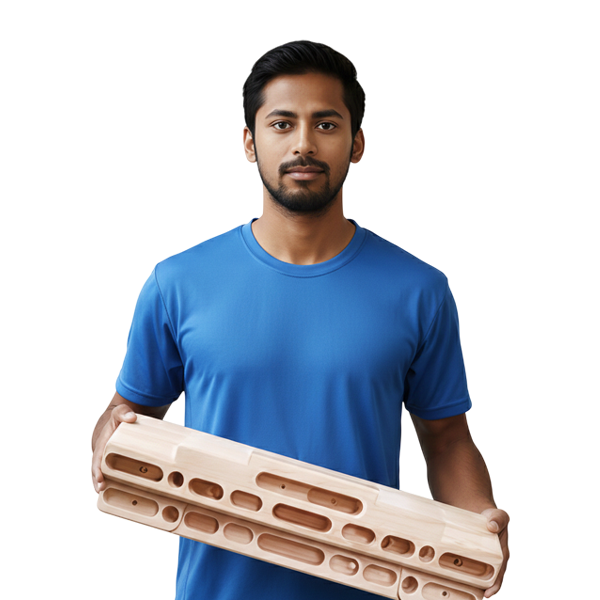
Fingerboard training for tendons (avoid overload),
Forearm, shoulder, and core strengthening,
Leg exercises for pushing and stabilization,
Mobility work for wrists, shoulders, hips, and ankles
Note: To protect your fingers from cuts, flappers, and abrasions, many climbers use finger taping: Ring / X-Tape, Spiral / Helix Wrap, Buddy Taping.
First Aid for Climbers
First aid follows the “3 P’s” principle:
• Preserve life,
• Prevent worsening of the condition, and
• Promote recovery.
Common Scenarios:
• Pain, Swelling, Loss of Strength: Stop, Ice, and Compression
• Sprain/Dislocation: RICE – Rest, Ice, Compression and Elevation
• Fracture: PRICE – Protection, Rest, Ice, Compression and Elevation
• Abrasion/Skin Tear: Clean with water, apply antiseptic, bandage, and keep dry
• Heat Exhaustion (Fatigue, Cramps, Headache): Move to shade, hydrate with water or ORS, wear light clothes
• Rope Burn: Run under cool water 10–20 min, gently wash; do not use ice, rub, or apply toothpaste/butter
• Head Injury (Confusion, Dizziness, Vomiting, Bleeding): Keep calm, monitor consciousness
Note: Anyone falling from 6 feet or higher should be treated as a potential head or spine injury.
Climbing challenges the body, sharpens the mind, and rewards those who respect its risks— train smart, climb safely, and enjoy every ascent.
March 21, 2026 | By Admin
Comments
Pankaj K.Bundle of Quick refreshment for Instructors. Very nicely written.
Thank you for your response.